
Contents
Quick Answer
A reading pen with clear human-voice pronunciation may be a useful way to replay words, model tone, and make a child’s book exploration more inviting. It does not, by itself, guarantee vocabulary learning. Children benefit most when pronunciation is connected to pictures, experiences, repeated readings, and responsive adult conversation.
What Can Human-Voice Pronunciation Add?
| Feature | Potential contribution | What still needs an adult |
|---|---|---|
| Clear recorded pronunciation | A repeatable listening model | Connect the word to a picture, action, feeling, or real-life experience |
| Replay control | More chances to hear a favorite word or phrase | Notice when repetition is enjoyable versus frustrating |
| Picture-book interaction | A prompt to point and explore | Ask, respond, and follow the child’s ideas |
| Multiple languages | Exposure to a second-language word or phrase | Use meaningful context and consistent family or educator support |
A pen feature is most useful when it supports a larger book conversation.
A natural voice can provide a consistent pronunciation model and make a repeated word or sentence easier to revisit. The value is strongest when the audio is matched to clear illustrations and an adult helps the child attach meaning: pointing, naming, adding information, or connecting the picture to a familiar event.
How to Use the Feature Without Turning Reading into a Drill
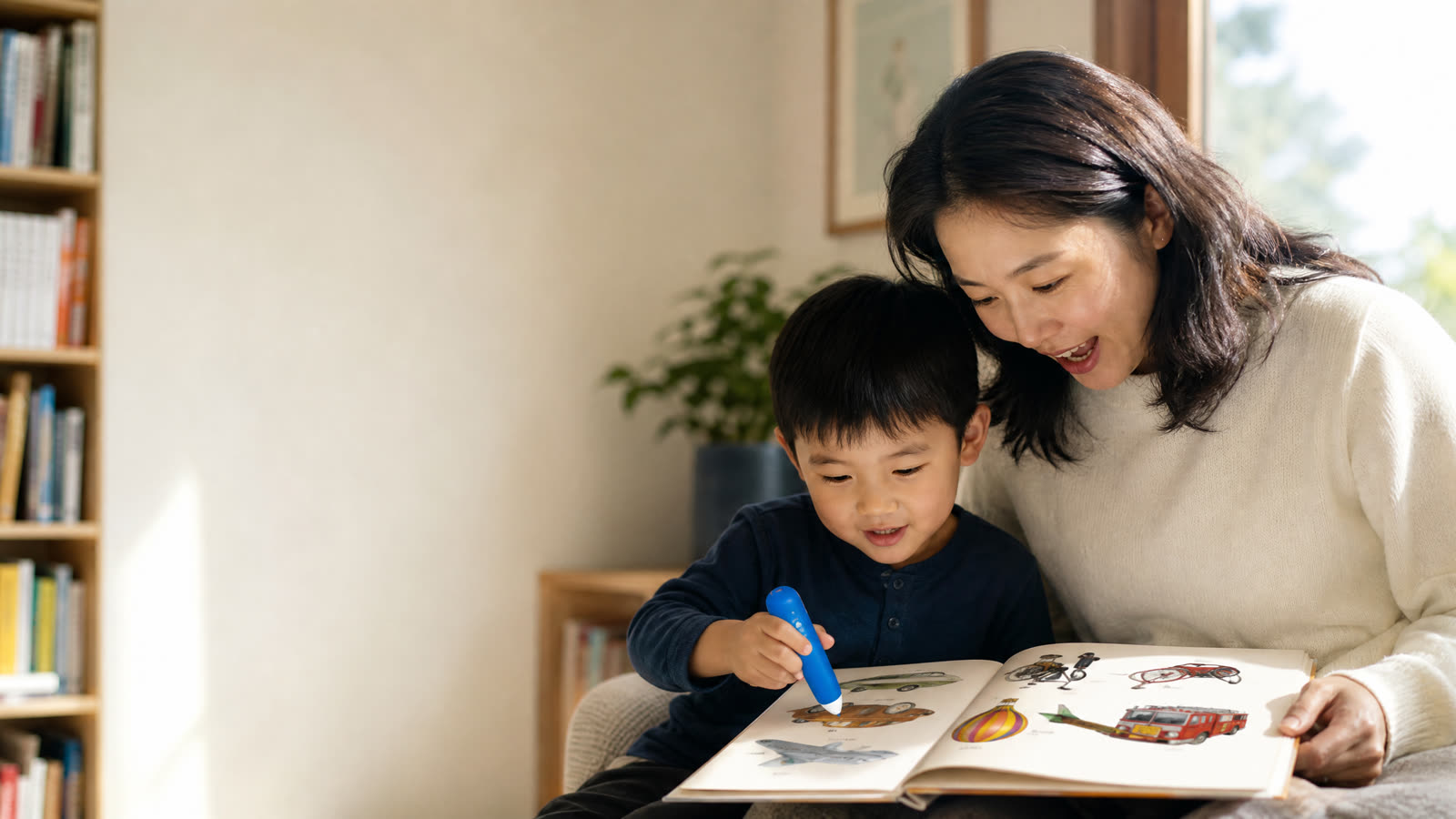
Start with a book the child already enjoys. Touch one word, listen, point to the picture, and use the word in a short sentence. Invite the child to choose another picture or repeat a phrase if they want to. NAEYC’s guidance on read-alouds emphasizes following children’s attention and making reading a dialogue rather than a test. [3]
What to Check Before You Choose a Pen
Listen for clear, respectful recordings; check that the content is age-appropriate; make sure the audio and book are aligned; follow product safety and age guidance; and choose a system with books worth revisiting. If pronunciation, language, or literacy concerns persist, discuss them with a qualified educator or health professional rather than depending on a device alone.